llms.txt: what it is, whether you need one, and how to write it.
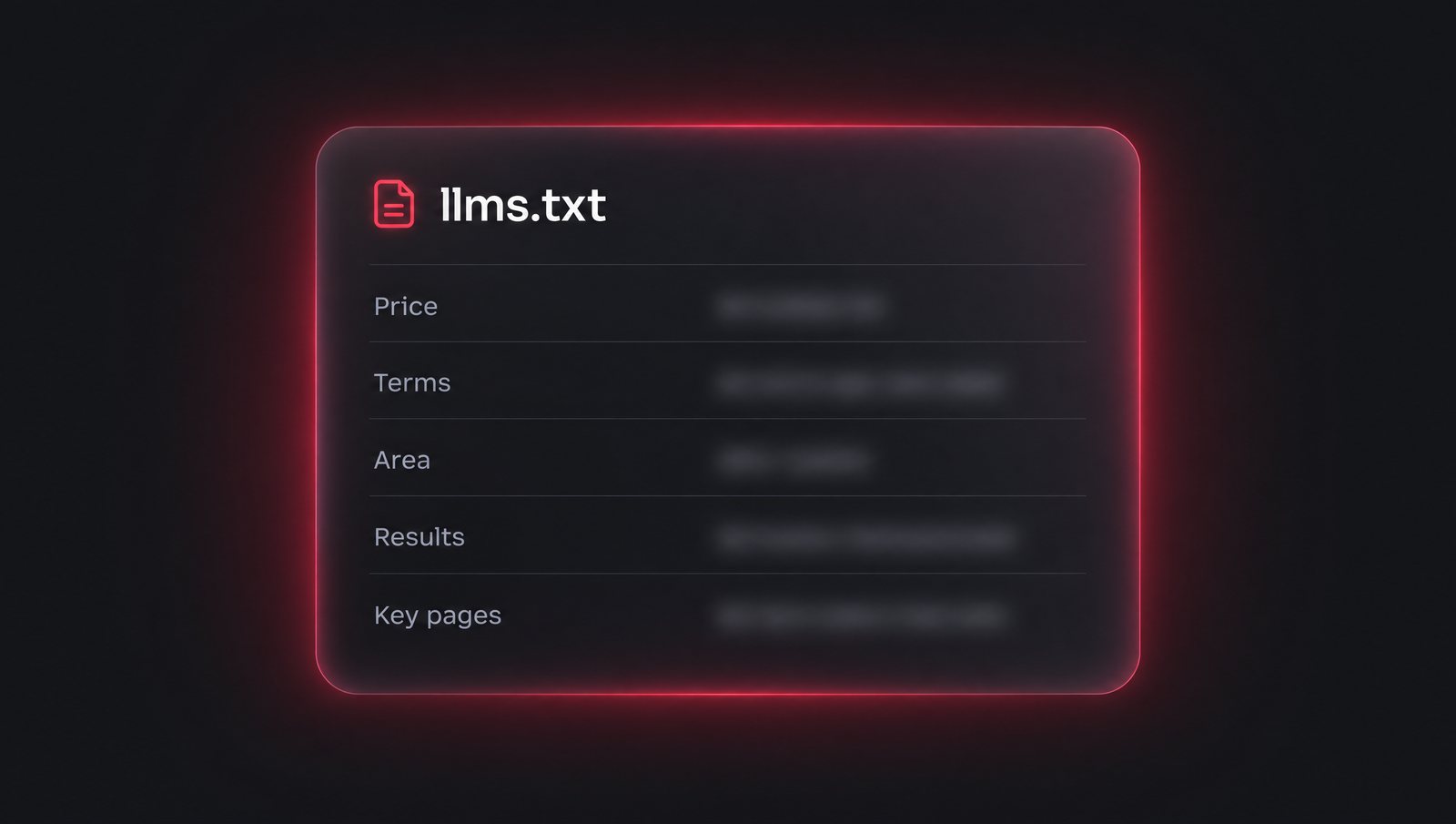
llms.txt is a short text file that sits at the root of your website, at yoursite.com/llms.txt, and tells AI tools in a few hundred words what your business is, who it is for, what it costs and which pages matter. Think of it as a fact sheet written for a machine.
Where it came from, and the honest caveat
Jeremy Howard of Answer.AI proposed it in September 2024, originally so documentation sites could hand language models a clean summary instead of a maze of HTML. It has since been picked up widely, especially by software and documentation sites.
The caveat matters: it is a proposal, not a standard. None of the big AI companies has said its crawler relies on llms.txt, and Google's AI Overviews are built from Google's normal search index. Anyone selling llms.txt as a ranking switch is overselling it.
Why we still write one for every site
Three reasons. It costs about an hour. Any AI tool or agent that does fetch it gets an unambiguous summary instead of guessing from your navigation. And writing it is a test: if you can't fill in the price, the terms and a real result, your website is missing the facts AI answers are built from, and that is the bigger problem.
When we launched Sable Management, its 9.7KB llms.txt carried the setup price, the management share, the notice period and the best result. Four days later ChatGPT quoted that pricing in an answer that named Sable first. The file didn't do that on its own; the same facts were on the pages too. But it is the clearest single statement of them.
What to put in it
- A heading with your business name.
- A one-paragraph summary in a quote block: what you do, for whom, and where.
- Key facts as short lines: prices, terms, service area, how long things take, contact.
- One or two real results with numbers.
- A list of your key pages, each with a one-line description and a full URL.
- Anything an assistant must get right, such as what you don't do.
The mistakes we see
- Marketing copy instead of facts. "Award-winning service" gives an assistant nothing to quote.
- Prices that go out of date. We caught ChatGPT quoting a plan one of our own launches had already dropped; old facts linger, so update the file the day a price changes.
- Serving it as a web page. It should be plain text at the root, not an HTML page wrapped in your site's design.
- Writing it once and forgetting it. It should change whenever your pricing, services or proof do.
How to check yours
Put your address into our free ChatGPT view. It checks whether you have an llms.txt and shows the start of it, alongside whether the AI crawlers can read your pages at all, which matters far more.
Write it in an hour, keep it true, and don't expect it to do the work your pages should be doing.
COMMON QUESTIONS
No. robots.txt tells crawlers what they may and may not fetch. llms.txt tells AI tools what your business is and which pages matter. You need robots.txt to let the AI crawlers in; llms.txt is the fact sheet they find once they are.
Google hasn't said it does. Its AI Overviews are built from Google Search's normal index, so what helps there is the content and structured data on your actual pages.
At the root of your domain, so it loads at yoursite.com/llms.txt, served as plain text. Most hosts and frameworks can do this directly; some platforms need a redirect or an app.
RELATED TERMS
Want to talk?
30 minutes, no pitch deck.